Go to Navigation
The Galapagos Islands

The Galapagos Islands

Read about the individual islands that make up the breathtaking Galapagos archipelago.

Bartolome (Bartholomew)

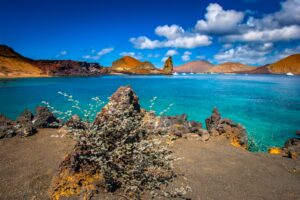
A small, barren island located in Sullivan Bay off James Island, Bartolome is one of the most popular anchorages and has two visitor sites. At the first, a climb to the summit of the island reveals probably the most scenic panorama in the Galapagos, an extraordinary combination of volcanic formations, lunar landscapes and the immense black lava flows on nearby James Island surrounded by the blue waters of the Pacific. The second site is a beautiful sandy beach in the shadow of a tall, eroded pinnacle which dominates Bartolome’s landscape, and offers some of the best swimming and snorkelling in the islands.

Daphne (Daphne)

Daphne is a small, conical island which has been somewhat eroded around its base by the action of the sea. The landing involves a steep scramble up the rocks to reach the start of the trail which climbs to the rim of the island’s twin craters where thousands of blue-footed boobies nest in season. Masked boobies can also be found nesting on the actual rim, and tropicbirds wheel overhead to complete an almost surreal setting.

Principal attractions: blue-footed and masked boobies, red-billed tropicbirds
Other attractions: swallow-tailed gulls, brown noddies

Espanola (Hood)

Site: Punta Suarez
This rocky promontory sustains one of the most impressive and varied colonies of sea birds in the Galapagos. Along its southern shore, high cliffs rise up from the sea and there are spectacular sightings of soaring birds.
Principal attractions: lava lizards, marine iguanas, mockingbirds, waved albatrosses (Apr-Dec), blue-footed boobies, masked boobies Other attractions: sea lions, red-billed tropicbirds, swallow-tailed gulls, Galapagos doves

Site: Gardner Bay
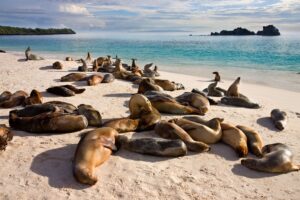
Located on the eastern end of the island with an excellent, sandy beach for swimming and observing the Galapagos sea lions.

Fernandina (Narborough)

Site: Punta Espinosa
The immense shield of Fernandina Volcano provides an impressive backdrop for Punta Espinosa, a narrow spit of sand and lava rock extending from the base of the volcano into the sea. Renowned for its large colonies of marine iguanas, it is also home to a number of unique Galapagos species such as the flightless cormorant, penguin, sea lion and marine turtle. The harshness of the recently formed volcanic landscape can be appreciated by following the trail inland to the edge of a large lava flow.

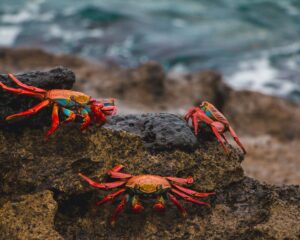
Principal attractions: brachycerces cactus, marine iguanas, flightless cormorants Other attractions: volcanic landscape, Sally Lightfoot crabs, Galapagos hawks, Galapagos penguins

Floreana (Charles)

Site: Punta Cormorant
Nestled between two volcanic hills, this lagoon is excellent for flamingos as well as a variety of shore birds and a number of unique plant species. The sand of the landing beach contains a large proportion of fine olivine crystals, a glassy volcanic mineral, giving the beach an olive-green tone.

Site: Devil’s Crown
A marine site located a short distance off Floreana which consists of the picket fence-like remains of a small volcanic cone which has been eroded away by the sea. The interior of the cone is an ideal habitat for several types of coral and marine life and offers superb snorkelling.

Genovesa (Tower)

Site: Darwin Bay
Behind the small beach which lies at the apex of the bay are a number of tidepools surrounded by cryptocarpus vegetation where colonies of frigate birds, red-footed boobies and swallow-tailed gulls make their nests. The trail follows the tidepools around the curve of the bay and is likely to be covered with water at high tide. Excellent views of the cliff formations along the coast, as well as the interior of the island, may be obtained by following the trail to its finish.

Principal attractions: frigate birds, swallow-tailed gulls, masked boobies, red-footed boobies
Other attractions: tidepools, sea lions, white-cheeked pintail ducks, yellow-crowned night herons, Galapagos doves, finches, lava gulls

Isabela (Albemarle)

Site: Urbina Bay
This area, located on the western coast of Isabela Island at the foot of Alcedo Volcano, was uplifted from the sea in 1954. The site is relatively flat and distinguished by corals and other marine formations which were deposited during the uplift. Flightless cormorants and pelicans nest along the coast. Principal attractions: coral and marine deposits, large marine iguanas, flightless cormorants, brown pelicans Other attractions: seashells, marine turtles, rays

Site: Caleta Tagus (Tagus Cove)
A favourite site for the early pirates and whalers, which is evident from the names of hundreds of ships painted on the high cliffs which enclose the protected bay (a practice now firmly discouraged!). In addition to this historical graffiti, the views of the salt water lagoon and the lava fields of Darwin Volcano make a visit to shore rewarding. There is also a good chance of seeing the elusive Galapagos penguin, flightless cormorant and other sea birds if one sails close to the foot of the cliffs.

Site: Elizabeth Bay
On Isabela’s western coast, Elizabeth Bay is an excellent area to observe a variety of marine species. There is a narrow inlet negotiable by panga (dinghy) which is lined with mangroves and emerges into an enclosed cove where marine turtles, rays and flightless cormorants may be seen in the sheltered waters.

Site: Alcedo and Sierra Negra Volcanoes
On the longer cruises, overnight hikes to the crater rim of one of Isabela’s active volcanoes can be arranged.

Plaza Sur (South Plaza)

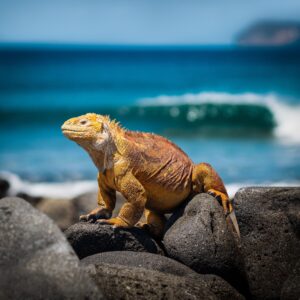
One of a pair of small uplifted islands lying just off the eastern end of Santa Cruz, South Plaza has a unique sesuvium and opuntia landscape which provides some of the most interesting wildlife observation in the archipelago. Land iguanas are easily spotted resting in the shade of cactus bushes beside the trail, swallow-tailed gulls, which nest on the rugged southern cliffs of the island, are commonly seen, and the rocky seashore is prime habitat for a large and noisy colony of sea lions.

Principal attractions: sesuvium, land iguanas, sea lions
Other attractions: opuntia cactus, pelicans, frigate birds, swallow-tailed gulls, Audubon’s shearwaters, red-billed tropicbirds

Santiago (James)

Site: Bahía Sullivan (Sullivan Bay)
This site offers a unique opportunity to observe a recent lava flow, together with all its attendant structural characteristics. Typical of the barren, volcanic landscape of eastern James Island, this area is composed of relatively flat, black pahoehoe lava, dotted with a series of pyroclastic cones which were engulfed by the lava as it flowed toward the sea. Tiny, fragile mollugo plants can be spotted growing out of the fissures as they begin to colonize the arid and barren terrain.

Site: Bahía James (James Bay)
Hundreds of marine birds rest on the cliffs and pinnacles of this narrow spit of land off the western end of James Island. While admiring the natural beauty of this area, it is worth remembering that pirates used this site for maintaining their ships and for supplies of fresh water, meat and firewood during the 17th and 18th centuries.

Rabida (Jervis)

Behind the picturesque beach on this small island lies a salt-water lagoon where flamingos are often seen. A side trail offers a view of the island’s interior and the nearby cliffs serve as roosting sites for several species of seabirds. San Cristobal (Chatham)

Site: El Junco Lagoon
Located high in the island at an altitude of 700 metres, this lagoon is one of the few permanent bodies of fresh water in the Archipelago. The lake and its surroundings are typical of San Cristobal’s humid zone and form a beautiful landscape. Principal attractions: landscape, white-cheeked pintail ducks, common gallinules Other attractions: miconia bushes, endemic tree ferns

Site: Kicker Rock
A magnificent rock in the middle of the sea which has the shape of a sleeping lion. The rock is divided into two parts by a narrow channel which small boats are able to negotiate.

Site: Isla Lobos
Only an hour away by boat from Puerto Baqeurizo Moreno, this small island is separated from the main island by a narrow stretch of calm water. Upon its rocky shores, blue-footed boobies nest (in season) and sea lions rest and play. The atmosphere is one of tranquillity and scenic primitive beauty, in which the visitor can fully enjoy a typical Galapagos environment.

Principal attractions: sea lions, blue-footed boobies
Other attractions: landscape, lava lizards

Santa Cruz (Indefatigable)

Site: The Highlands
The highlands of Santa Cruz provide the best example of the miconia zone and the pampa zone (low vegetation) which typify the high areas of all the islands. The ‘twins’, an extraordinary pair of deep volcanic caldera, are one of the main attractions of this region, and there are wonderful panoramic views of rolling hills and extinct volcanic cones.

Principal attractions: the ‘twins’, typical humid zone vegetation, miconia bushes, scalesia trees
Other attractions: pampa (fern-sedge zone), extinct volcanic cones, vermilion flycatchers

Site: Charles Darwin Research Station
Although the great majority of Galapagos visitors come to observe and appreciate the area’s natural wonders, it is also interesting to learn how the protection and conservation of the islands is carried out. A visit to the Charles Darwin Research Station will increase one’s understanding of the work being done and stress the importance of maintaining the islands’ ecosystems, and the endangered species which comprise them, in their natural state so that future generations may enjoy them for many years to come.

Principal attractions: adult Galapagos tortoises in captivity, centre for raising young tortoises, Van Straelen Exhibit Hall

Site: Caleta Tortuga (Turtle Cove)
This impressive marine site consists of a deep maze of tranquil sea water inlets surrounded by mangrove thickets. The still and murky waters of the cove are a favourite resting (and mating) place for marine turtles, rays and small sharks.

Santa Fe (Barrington)

The small bay on Santa Fe’s north-east coast is an extremely picturesque anchorage and there is a choice of two trails available. One leads to a scenic clifftop viewpoint and an area where a species of land iguana endemic to the island can sometimes be seen; the other to an unusually tall forest of prickly pear cactus.

Principal attractions: forest of opuntia cactus, land iguanas
Other attractions: snorkelling off the beach, sea lions

Seymour Norte (North Seymour)

Located slightly to the north of Baltra, North Seymour is a low, flat island formed by the uplift of a sub-marine lava formation. It is covered with scrub and bush vegetation and contains the largest colony of magnificent frigate birds in the Galapagos. There is also a large population of blue-footed boobies when nesting conditions are right.

Principal attractions: magnificent frigate birds, blue-footed boobies
Other attractions: endemic palo santo, sea lions, fur seals (occasional), swallow-tailed gulls, brown noddies, mockingbirds

The Ultimate Travel Company

The Ultimate Travel Company offers every kind of travel experience imaginable - from tailor-made journeys and luxury beach holidays to escorted cultural tours and weekend breaks in Europe. Our destination specialists look forward to sharing their experiences, and using their unrivalled knowledge to create your ultimate holiday.

Read more About Us or Meet the Team.